For decades the Toyota Estima has been Japan’s answer to the family-friendly, tech-forward minivan: roomy, often clever, sometimes quirky, and frequently ahead of the market when it comes to hybrid tech and onboard features. Known outside Japan most commonly as the Previa (and in Australia as the Tarago), the Estima was sold in Toyota showrooms from 1990 until production wound down in 2019. Below you’ll find a generation-by-generation breakdown of the JDM Estima — what changed, what was noteworthy, and why the model retained its cult following among enthusiasts and families alike.

First generation – 1990–1999: the mid-engine oddball (XR10 / XR20 / TCR10)
Toyota launched the Estima/Previa in January 1990 with a memorable engineering choice: a transverse, mid-mounted inline-4 installed almost flat beneath the front seats. That layout (plus some creative packaging) maximized interior space and gave the Estima its distinctive, almost futuristic silhouette. Early JDM lineups included rear-wheel drive and All-Trac all-wheel-drive variants and a 2.4-litre 2TZ-FE inline-4 as the mainstream powerplant; a supercharged 2.4 (the 2TZ-FZE) arrived later for higher-output trims. The first generation was also sold in Japan in narrower/shorter variants — the Estima Lucida and Estima Emina — to hit lower tax brackets.

Notable JDM highlights:
- Unique mid-engine packaging that set it apart from competitors.
- One sliding door (early models) and an interior that prioritized passenger volume over traditional engine bay layout.
- Diesel options (in some dealer channels) and the Lucida/Emina two-width strategy to suit Japan’s dimension/tax rules.

Second generation – ~2000–2006: front-engine, more conventional, and the birth of “Estima Hybrid” (ACR30 / ACR40)
With the 2000 model change Toyota moved the Estima away from its mid-engine roots to a conventional front-engine, front-wheel-drive layout (with available AWD). This made the handling and serviceability more familiar to buyers and aligned the Estima with how minivans were evolving globally. The styling smoothed out, seats became more modular, and interior flexibility improved — sliding second-row seats, fold/split third row, and more creature comforts for families.

Notable JDM highlights:
- A wider engine roster and more mainstream packaging to compete head-on with rivals in Japan and export markets.
- The platform changes made later hybridisation and electronics easier to integrate.
- The hybrid milestone — Estima Hybrid (first seen in 2001)

One of the most important chapters for the Estima in Japan was the early adoption of Toyota’s Hybrid Synergy Drive. Toyota introduced the Estima Hybrid in 2001 (production for Japan starting May 2001), which combined a gasoline engine with electric motors to drive the wheels — Toyota says this made it the world’s first hybrid minivan when introduced. The Estima Hybrid used a front-mounted 2.4-litre and electric motors (front and rear motor setup on some variants) and offered significantly improved urban fuel economy compared with conventionally powered models. This hybrid Estima would be an important precursor to many of Toyota’s later electrified MPVs.
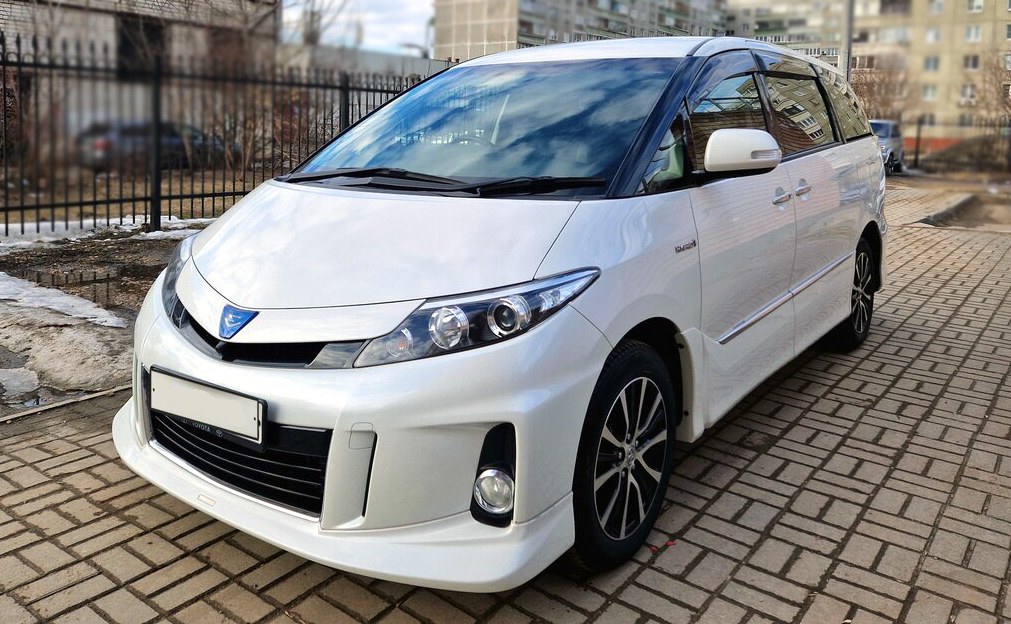
Third generation – 2006–2019: tech-heavy, refined, and the mainstream hybrid (AHR20 / ACR50 / GSR50 / XR50)
The third-generation Estima (launched in 2006 in Japan) is the model many think of when they picture a modern JDM Estima: smooth, aerodynamic, and available with Toyota’s second-generation hybrid tech. It shipped with a range of engines (notably the 2.4-litre 2AZ-FE inline-4 and, in some trims/markets, a 3.5-litre V6). The hybrid AHR20 model combined a 2.4 petrol engine with electric motors and an e-Four AWD system on select versions. Feature-wise, Toyota loaded the Estima with items that were advanced for the class: automatic parallel and reverse parking, Lane-Keep Assist, Adaptive Front-Lighting System (AFS), power-reclining track-mounted second-row seats with footrests, and power-folding third row seats on higher grades. The model received facelifts in 2008/2009 and later around 2016, slimming down the V6 presence and leaning into the hybrid and 2.4-litre variants for efficiency.

Notable JDM highlights:
- Estima Aeras: a popular trim/appearance package with aerodynamic bodywork and a more premium look aimed squarely at Japanese families who wanted van comfort with carlike style.
- Advanced driver assists (LKA, AFS) were offered ahead of many competitors in the segment — a clear JDM emphasis on tech.
- Hybrid variants were sold primarily in Japan and some Asia markets (limited official presence elsewhere) and became the go-to choice for buyers looking to balance passenger capacity with fuel economy.
Models, codes and JDM dealer quirks (short primer)
Toyota often split Estima/Previa sales across different dealer channels in Japan, and also used sub-names (Estima Lucida / Emina in Gen-1, Aeras in later gens) to create dealer-specific lineups. Model codes you’ll encounter in JDM paperwork include AHR20 (hybrid third gen), ACR30/40/50 (various second/third gen petrol chassis codes), and GSR50 (V6 third-gen variants in some markets). These codes are useful when looking up parts, trim levels, or auction listings.
Why Toyota retired the Estima (and legacy)
Production ended in 2019 as Toyota reshaped its global MPV line-up and as market demand for large minivans declined in many regions in favour of SUVs and crossovers. In Japan, the Estima’s role was partly absorbed by other Toyota offerings (Alphard/Vellfire for near-luxury MPV buyers and other crossovers for mainstream customers). Still, the Estima left behind a legacy as one of Toyota’s most innovative family vehicles — early hybrid adoption, creative packaging, and a long production run that made it a mainstay in JDM circles and a familiar candidate for overseas importers.

Practical notes for buyers and enthusiasts (JDM perspective)
Which generation to choose? If you want the quirky, cult classic — a first-generation XR10 has character (and the distinctive mid-engine layout). If you want hybrid economy and the most modern safety/comfort tech, look to later second/third-generation AHR20 hybrids. For parts availability and conventional servicing, the second and third generations are easier and cheaper to maintain.
Common gotchas: Early mid-engine Estimas can be more involved to service (engine access differs), and some JDM auction listings will use many different model codes — always cross-check VIN/model code when buying/imports.
Hybrid longevity: Toyota’s hybrid systems are generally robust, but battery and inverter health should be inspected on high-mileage JDM imports; service history matters.

Quick timeline (essential dates)
- 1990: First-generation Estima/Previa debuts (mid-engine).
- ~2000: Second generation arrives; front-engine layout adopted.
- 2001: Estima Hybrid goes on sale in Japan — an early (arguably the first) hybrid minivan.
- 2006: Third generation launches with broader hybrid availability and advanced driver assistance options.
- 2019: Production ends (Estima retired).


