If you’ve ever used a diagnostic scanner to check your vehicle’s check engine light, you’ve probably heard the terms OBD1 and OBD2. While both systems are designed to monitor vehicle performance and detect problems, there are significant differences between them.
What Is OBD1?
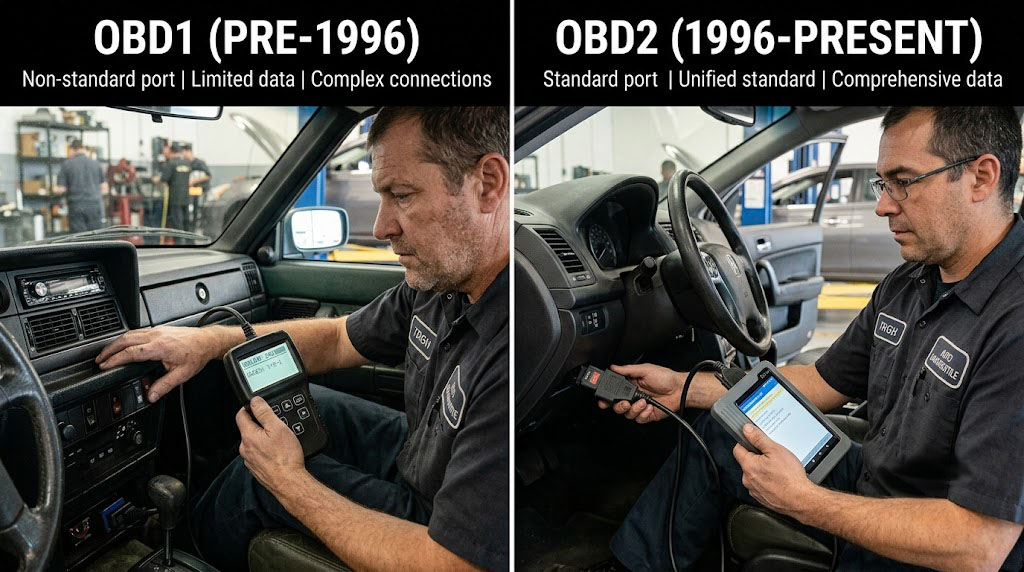
OBD1 (On-Board Diagnostics I) was the first generation of onboard diagnostic systems introduced in the 1980s. Each vehicle manufacturer developed its own diagnostic system, connectors, and fault codes. As a result, diagnosing problems often required brand-specific scan tools and service manuals.
Because there was no universal standard, OBD1 systems varied widely between manufacturers, making diagnostics more complicated.
What Is OBD2?
OBD2 (On-Board Diagnostics II) became mandatory for all passenger vehicles sold in the United States beginning with the 1996 model year. Unlike OBD1, OBD2 uses a standardized 16-pin connector and a universal set of diagnostic trouble codes, allowing one scanner to work with nearly all modern vehicles.
In addition to reading and clearing trouble codes, OBD2 diagnostic scanners can display live engine data, monitor emissions systems, check sensor readings, and assist with advanced vehicle diagnostics.
Key Differences
- Standardization: OBD1 systems are manufacturer-specific, while OBD2 follows universal standards.
- Connector: OBD1 connectors vary by manufacturer, whereas all OBD2 vehicles use the same 16-pin diagnostic port.
- Diagnostic Codes: OBD2 uses standardized trouble codes that are consistent across most vehicle makes.
- Capabilities: OBD2 provides access to live data, emissions monitoring, freeze-frame information, and more advanced diagnostics.
Which One Do You Need?
If your vehicle is a 1996 model year or newer, it almost certainly uses OBD2, making it compatible with most universal OBD2 scanners. Older vehicles may use OBD1, requiring a manufacturer-specific scanner or adapter.
Final Thoughts
OBD2 represents a major improvement over OBD1 by providing standardized diagnostics that make troubleshooting faster, easier, and more accurate. Whether you’re a professional mechanic or a DIY car owner, an OBD2 scanner is an essential tool for identifying problems, monitoring vehicle performance, and saving time on repairs.